Okay so I have an additional 6 pounds to lose to get back to my pre-pregnancy weight. In addition, I would like to lose an additional 7 pounds to put me at my ideal weight. So I'd like to lose 13 pounds in all. Coupled with the fact that after delivery and gestational diabetes, Christmas came around and I ate way too much sugar (my mil made 8 different batches of cookies), I've decided to try a sugar detox program. I've always known that I was sensitive to sugar but it really hit home this Halloween. While my friends and I were enjoying a pedicure, a bowl of candy corn was brought out. As I dove in for handfuls, some of my friends started making comments about how gross candy corn is. One of my friends said she could only eat one because they are so sickeningly sweet. The others nodded. I told them I could probably eat the entire bowl. That's when I started thinking about it. Chocolate, Peeps, sweethearts, ice cream, birthday cake, pie, jelly beans, etc. If it's got sugar in it, I'd eat it. So after Christmas, I decided it was time to try to detox from refined sugar and simple carbs. I started reading, "The Sugar Addict's Total Recovery Program" by Kathleen DesMaisons after it got rave reviews on Amazon. I officially went off overt sugar and all white foods December 27. I'm curious to see how detoxing from sugar will effect my body and mood. I've lost weight already and can tell my stomach looks flatter. I've had a bit more energy, which is a real plus since I'm having to take care of two little girls now. No headaches, and no major bouts of palpitations. Just a little depressed every evening after dinner since I miss having dessert. I hope to go 3 months strong without eating any sugar. After that, I have to watch my sugar addiction for another 6 months before I might be able to eat a cookie without wanting another dozen. My overall goal is not to go off sugar forever, but just to be able to get to a place where I can eat a handful of M&Ms without feeling like I need more. Wish me luck.
Friday, January 6, 2012

A Funny Thing Happened on the Way to the Delivery Room
My beautiful and healthy (praise God) daughter was born November 17, 2011. We are all doing extremely well. A bit sleep deprived, but adjusting well to a family of four. My older daughter is in love with her new baby sister and has been a great helper. Labor was a bit more difficult than with my first as I labored a lot longer without an epidural. After experiencing intense contractions 3-5 minutes apart for over 8 hours, it was time the anesthesiologist came in. As he started prepping me, he started asking me the standard questions, such as have I ever had heart disease, etc. Seldom do doctors ask about heart arrhythmia per say so I went ahead and started filling him in. While groaning through contractions, I spoke of PVCs, and of bigeminy, of my cousin and possible Long QT in our family. I mumbled stuff about tachycardia and fibrillation. That's when the anesthesiologist looked up from his paper he was taking notes on and asked "Are you a nurse?" I asked why he thought I was one and he told me that the terms I was throwing out made it seem like I had a medical background. Ha! Nope, I've just experienced these little buggers for so long, and I have wanted to educated myself about my heart. I actually took it as a great compliment. You always hear that you have to be your biggest health advocate and the fact that I was able to convey my medical history (even in great pain) made me proud. The epidural took and less than 2 hours later and a few pushes, my daughter was out. Recovery has been relatively easy, and post partum I haven't experienced too many premature ventricular contractions - medical jargon for "the dance". I bet the anesthesiologist would have even gotten a greater kick out of it if he had known I blog about the subject.
Tuesday, September 20, 2011
“I still got my rhythm...I still got it.”

My most recent comment (from the posting The Good, the Bad, & the Ugly) came from a fellow palpitation sufferer who in addition to PVCs and PACs has experienced bouts of atrial fibrillation. I have fortunately not experienced this condition, but it seems as Mr. Copacabana himself, Barry Manilow, has had his heart out of rhythm for over 15 years.
The following comes from FoxNews
By Colleen Cappon & Melissa Browne Weir
Published September 19, 2011
As a music icon, no one knows the value of being in rhythm more than the legendary Barry Manilow.
For more than 15 years, however, Manilow has continued his success while one critically important detail was out of rhythm—his heart. That's because he is one of the more than 2.5 million Americans living with atrial fibrillation or AFib.
AFib is a condition that causes your heart to race and beat out of rhythm. While some people with AFib may feel no symptoms, others may feel palpitations, shortness of breath, weakness and anxiety.
People often aren’t aware of many of the serious consequences of this disease, including permanent heart damage, heart attack, heart failure, stroke and death. In fact, many patients currently living with the disease may not know if their AFib management plan is addressing these important risks.
“The first time it happened to me, I was actually driving home. I could feel something strange happening; I wasn't jogging, I was singing, I wasn't jumping around at the Copacabana,” Manilow said.
With no risk factors and not knowing what was happening to him, he called his doctor to run some tests.
“I went to him, and he explained that this condition is called atrial fibrillation. He put me on a regimen of medicine and all, and for a while it calmed down. Then it started up again, and they had to go further for me,” Manilow said.
Dr. Marcus Wharton, director of cardiac electrophysiology at the Medical University of South Carolina, said Manilow isn’t alone with this problem.
“The majority of people who get it are over the age of 65, but it can hit younger people as well," Wharton said. "The number of people suffering from atrial fibrillation is expected double or triple over the next 10 years as the baby boomer generation ages.”
Manilow is now the patient spokesperson for Get Back in Rhythm, a national atrial fibrillation education campaign to encourage people to learn about the importance of managing the disease.
“I know these episodes are scary. It starts out very innocent, your heart skips a beat. And then it goes further and your heart starts going faster, beats faster and faster and faster, until you know there's something wrong," Manilow explained. "It's out of whack, it's out of rhythm."
Wharton said approximately 25 percent of people are have no symptoms at all and are not even aware that they suffer from atrial fibrillation.
"It can cause a change in exercise tolerance, fatigue, and so people think they are just getting old. It is important to see your cardiologist if you have any of these symptoms,” Wharton added.
Manilow said he is speaking out about his disease because of his fans.
“I worry about you guys who are not calling your doctors, who are going through this and who are afraid to go to the doctor or don't like doctors," he said. "You can't let this go, cause you're playing with fire, cause this could go to heart attacks and strokes. You've got to take care of this.”
Manilow reassured his ‘Fanilows’ that he is in great shape and feels well.
“I still got my rhythm… I still got it.”
To see if you are at risk for AFib, and to learn more about Barry Manilow’s story, log onto www.GetBackinRhythm.com.
Thursday, September 1, 2011
The Good, the Bad, & the Ugly
Have you ever experienced heart palpitations when something exciting happens? Last night, my hubby won a major award at the Austin Chamber of Commerce Awards. He and his friend started a small company called PrimoDish and they beat out some serious competition to win the 2011 Austin Business Award for Technology in the Small Business category. I was so happy for him that my heart skipped for joy! That's the good kind of heart palpitations.
Skip to 12 hours later. After waking up still tired and then having to present a speech at my church's Annual Women's Meeting, taking care of a grumpy toddler, receiving some discouraging news about a friend, and dealing with with a nasty tension headache, I laid down on my bed only to experience a series of skipped beats. I'm sure I was in bigeminy for a minute or so before I switched positions and the palpitations diminished. Needless to say, those are the ugly kind of heart palpitations.
Sunday, August 21, 2011
Pregnancy Anemia
So I recently had my blood drawn at my 28 week appointment. I discovered 2 things. One, I failed my one hour glucose test, which means I have to go in tomorrow for the 3 hour test. I was gestational diabetic with my first daughter, and I'm expecting the same diagnosis later this week. I also discovered that I was anemic so I need to start taking iron supplements. One of the symptoms of anemia in addition to fatigue, shortness of breath, and headaches is...heart palpitations. Bingo. Maybe that's why I've been feeling so many of those nasty misbeats lately. And hopefully, now that I'm taking the iron pills, I'll see a reduction in the number of palpitations I get (especially before bedtime.)
Fingers crossed.
Wednesday, August 17, 2011
Left or Right Side?
I mentioned in my last post, that I tend to experience more palpitations when I lay on my left side before falling asleep. So, I usually find relief when I flip over and lay on my right side. I've heard conflicting thoughts about whether to lay on your left or right side. I'm of the mind, you do what works best for you.
But since I'm curious, do you find a better side to relieve heart palpitations when you lay down? I'd love to hear from you.
The right side vs. the left side???
Thursday, August 11, 2011
And the Beat Goes On
I'm so sorry to all my readers. I have been an absolute horrible blogger recently. I got pregnant and that caused a whole myriad of things to prevent me from blogging regularly (nausea, fatigue, keeping up with a toddler, appointments, etc).
But I'm doing well, and I'm nearing the end of my second trimester. We found out that we are having another little girl (yay for sisters!) and she's due to arrive in mid November.
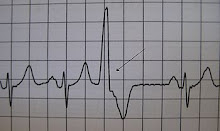
How are my heart palpitations these days, you may ask? Oh, they are a pretty active right now! Some women say that pregnancy makes them better and others say that they make them worse. In fact, many women first experience the sensation of palpitations when they become pregnant. This causes many anxious and frightened mama-to-be's to report this symptom to their doctors. Usually, the doctor reassures the mama that these are normal and for many lucky women, they go away after pregnancy.
Mine come almost every day. Some really scare the beejeezus out of me. But for the most part, I've come to accept their annoyances. They are especially bad as I lay down before I go to sleep. I've noticed that if I lay on my right side, they seem to diminish somewhat. And if they are really annoying, I'll sometimes prop myself up with several pillows and sleep upright. They are not too bad when I'm active, but no surprise there. Most of us PVCers are more aware of them when we are sedentary. That doesn't mean they don't occur when I'm up and about; I just don't feel them.
I'm most nervous about the heart palpitations during the post-partum period. Lack of sleep and caring for a new baby and a toddler is a recipe for stress-induced palpitations. I've mentioned before on my blog that my cousin Beth past away within the year of giving birth to her 4th child. There has been much discussion over the cause of her death, but most of her doctors think that she may have had Long QT syndrome, a condition that causes palpitations, fainting, and sudden death. Findings indicate that among women with LQTS who gave birth, the 9-month postpartum time is associated with a 2.7-fold increased risk of experiencing a cardiac event and a 4.1-fold increased risk of experiencing a life-threatening event when compared with the preconception time period. After this transient high-risk postpartum period, the risk of cardiac events reverts to the baseline pre-pregnancy risk. What does this all mean for me? I've been tested over and over and my doctors feel fairly certain that I do not have this genetic condition. So, I shouldn't worry about an increase risk of sudden-death during the post partum period. But when you have a family member die after giving birth, it does make you a bit anxious.