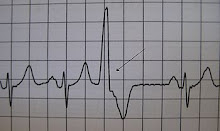
What do I have in common with Queen Rania of Jordan? Well, besides the fact that we're both stunning brunettes (insert smiley face), it looks like she suffers from premature ventricular contractions just like me. Imagine, a royal queen suffers from these annoying irregular heart beats. It's not just a commoners disease. On a serious note, Queen Rania had a non-surgical heart procedure at the end of Sept. in an attempt to normalize her heart's rhythm. Although the article doesn't specifically go into detail about the procedure, it sounds like it was an ablation based on the description.
Jordan's Queen Rania undergoes treatment for irregular heart rhythm
It sounds like she is recovering and doing well. May she live happily ever after.
Friday, October 8, 2010
What I Have in Common with Her Majesty the Queen

Yoga is Not a Religion
Just thought I would address this issue and nip it in the bud since I talk a lot about meditation/yoga helping ease the symptoms of anxiety and heart palpitations.
A friend recently sent me a link to an ABC news article about a Southern Baptist leader who is calling for Christians to avoid yoga saying that "the meditative discipline is not a Christian pathway to God." And then I got on facebook today and my teenage sister-in-law had written this on her status update: "Some ppl think yoga will send you to hell but I think it brings you to a heavenly bod!"
Oh Lord, give me strength. Here's the article:
Southern Baptist Leader on Yoga: Not Christianity
Besides the utter ignorance of this Baptist leader, I believe this particular individual is spreading fear to many people who might benefit from yoga both physically and spiritually. We all know the benefits of yoga physically (flexibility, strength, posture, heart health), but it can also have great spiritual benefits. But let's be clear spirituality is different than religion. Spirituality has to do with one's inner life, the ever-evolving understanding of one's self and one's place in the cosmos—what Viktor Frankl called humankind's "search for meaning." Religion, on the other hand, can be seen as spirituality's external counterpart, the organizational structure we give to our individual and collective spiritual processes: the rituals, doctrines, prayers, chants, and ceremonies, and the congregations that come together to share them. Yoga was rejected by Hinduism because yoga would not insist that God exists. It didn't say there was no God but just wouldn't insist there was. Yoga is not a religion, but the science of religions. Yoga demands discrimination rather than faith. Where most religions teach us 'what to do', Yoga teaches us 'how to be'.
And what do some of the great yogis think?
Swami Sivananda Saraswati: "Yoga is not a religion, but an aid to the practice of the basic spiritual truths in all religions. Yoga is for all, and is universal."
Georg Feuerstein: [To practice yoga] "You need not believe in anything other than the possibility that you can transform yourself." "...some Yoga practitioners are more religious than others. But Yoga itself is simply a tool for exploring the depth of our human nature, of plumbing the mysteries of the body and the mind.
Shri Ram Sharanam Ashram: “Yoga is not a religion. it is not necessary for you to believe in a certain god or to chant certain hymns. it is spiritual and ancient science, which leads to health in the body, peace in the mind, happiness in the heart and liberation of the soul.”
Pandit Usharbudh Arya: “Yoga is not a religion or a church. It requires no belief in a doctrine, no credo. All yoga philosophy is concerned with the experience of meditation and nothing else. It does not require anyone to adhere to a belief system.”
Osho: “First, yoga is not a religion—remember that. Yoga is not Hindu, it is not Mohammedan. Yoga is a pure science just like mathematics, physics or chemistry. Physics is not Christian, physics is not Buddhist. If Christians have discovered the laws of physics, then too physics is not Christian. It is just accidental that Christians have come to discover the laws of physics. But physics remains just a science. Yoga is a science—it is just an accident that Hindus discovered it. It is not Hindu. It is a pure mathematics of the inner being. So a Mohammedan can be a yogi, a Christian can be a yogi, a Jaina, a Buddhist can be a yogi.”
When I practice yoga, I contemplate the mysteriousness of the Holy Spirit and my eye is towards Jesus in heaven. My meditations are no different than King David's prayers. Yoga renews my spirituality, but it certainly is not my religion.
Tuesday, October 5, 2010
My Own Happiness Project
Now that I finished reading The Happiness Project (see my previous blog), I've decided to come up with some resolutions of my own. These are things that either brought or currently bring happiness to my life. And since Rubin worked on one resolution per month, I thought I would come up with at least 12. The list is in no particular order.
1) Blog regularly
2) Jog at least 3 times a week
3) Make time for yoga/meditation
4) Be musical (start playing the piano again and singing in the choir)
5) Dance
6) Laugh more
7) Keep 9 to 10 p.m. for my husband Jake
8) Mission/Volunteer
9) Pray
10) Contemplate the Heavens (remember my loved ones)
11) Read novels written in Italian
12) Renovate my kitchen
Do you have resolutions of your own? I would love to hear what some of you do to make yourselves happy! :)
Monday, October 4, 2010
Ruby Slippers

Dorothy: Oh, will you help me? Can you help me?
Glinda: You don't need to be helped any longer. You've always had the power to go back to Kansas.
Dorothy: I have?
Scarecrow: Then why didn't you tell her before?
Glinda: She wouldn't have believed me. She had to learn it for herself.
Scarecrow: What have you learned, Dorothy?
Dorothy: Well, I—I think that it, that it wasn't enough just to want to see Uncle Henry and Auntie Em — and it's that — if I ever go looking for my heart's desire again, I won't look any further than my own backyard. Because if it isn't there, I never really lost it to begin with! Is that right?
Glinda: That's all it is!
Scarecrow: But that's so easy! I should've thought of it for you -
Tin Man: I should have felt it in my heart -
Glinda: No, she had to find it out for herself. Now those magic slippers will take you home in two seconds!
Dorothy: Oh! Toto too?
Glinda: Toto too.
Dorothy: Now?
Glinda: Whenever you wish.
...
Glinda: Then close your eyes and tap your heels together three times. And think to yourself, 'There's no place like home'.
I woke up again in the middle of the night last night. This time I was in an intense dream and woke up to a few heart palpitations. This in turn set about a physiological response and my anxiety levels rose once again. As I started into panic mode, I remembered the lesson of the ruby slippers. Perhaps, I was still on a kick about childhood memories as The Wizard of Oz had been my favorite movie to watch while growing up. I remember we didn't own a VCR back in those days so my dad would sometimes bring the VCR from his work home as a treat. It would take him a good hour to hook it up to the TV and track down a copy of the Wizard of Oz from our local Blockbuster. When it was finally time to watch and we all gathered onto the couch, I felt giddy with excitement as the opening credits rolled onto the screen. I haven't thought a lot about the movie in recent years but last night I couldn't get the dazzling ruby slippers out of my mind. I remembered Glinda telling Dorothy that she "always had the power." And when it comes to dealing with heart palpitations and anxiety, nothing could be truer. I have the power to decide whether or not I'm going to let it bother me. I have the power to accept what ever comes my way. I can choose whether or not I'm going to have a good day or a bad day. I've always had it in me. I don't need anyone else. I hold the power of the magic ruby slippers. And nobody can help me except for me. I have to believe if for myself.
And as a reminder, I'm thinking I might purchase a little reminder such as this cute one from Etsy: Wizard of Oz tile jewelry pendant
Sunday, October 3, 2010
Pat the Cat

I've recently been reading The Happiness Project by Gretchen Rubin and although most of the book is pretty general about how to be happy (i.e. get more sleep, exercise, start laughing more, find your interests, etc.), I was struck by the reminder that "regularly having fun is a key factor in having a happy life; people who have fun are twenty times as likely to feel happy." And I wonder when I start experiencing heart palpitations (which are obviously no fun), how much fun had I been having prior to their onset? Most likely, not so much. In fact, if stress is the number one reason for my heart palpitations, how can I de-stress? Be serious about play. As Rubin explored how to have more fun, her friend posed the question to her: "What did you like to do when you were a child? What you enjoyed as a ten-year-old is probably something you'd enjoy now." As I muddled this over in my head, I tried to think of some of the things I liked to do as a ten-year-old. I loved to read books, play with friends, cuddle my cat, dance to music, draw/color, play house, and ride my bike. Some of these things I still do such as reading and obviously "playing" house. But some of these things I haven't done in a long time. When is the last time I put on the Ventures and danced to "Walk, Don't Run"? Last night, I woke up around 1 a.m. I was nervous before I fell asleep because I was afraid I might have another panic attack, and sure enough the anticipatory anxiety woke me up in the middle of the night. As I could feel my anxiety level rise, I thought about what I had enjoyed as a child. I turned myself over in bed so that my head was now at the end of the bed and my feet were on my pillow. My cat Quinn was curled up in a small ball. I started petting him and the sweet sound of his purring soothed my soul. I remembered fondly the days of petting my childhood cat, Midnight. I felt at peace, and it was so wonderful to do something childlike again. Something so simple, but something I had long neglected. I simply got to pet my cat. I fell peacefully asleep to the hum of his tiny motor.
Saturday, October 2, 2010
Know Thy Limits or Suffer Thy Consequences
My little girl turned 2 last Sunday, and she is every bit of a toddler. Preparing for her party and then having something to do EVERY evening this past week, wreaked havoc for me last night. I had a panic attack that lasted for hours last night. Yep, you heard me, hours! Usually when I get a panic attack, they last a few minutes but this one was the mother of all panic attacks. For 2 hours, I contemplated going to the hospital. I would breathe well and then forget to breathe and then the panic cycle would start all over again. The reason for all of this panic? Balance. Or lack there of. When I'm feeling well and generally not experiencing heart palpitations, I tend to start taking more things on. I start feeling "normal" again and feel like I can do it all. So I stack up my calendar with one thing after the other, take on more responsibilities, and forget all my important preventative measures (like regular exercise, healthy eating, meditation, etc.). So when I woke up this morning after the horrendous night, I knew what I needed to do to prevent this acute anxiety from returning. Go back to square one. I need to re-examine my life and start finding that much needed balance. I'm off for a walk on this beautiful Fall day in Central Texas. :) And that brings peace to my soul.
Wednesday, August 25, 2010
A cautionary tale of PVCs in the workplace

Okay, I've been dreading this post. I've wanted to do it for awhile but every time I start to think about it, I hesitate because in some ways I think I'm still traumatized. It's going to be a long post, so if you don't read it all, that's okay. It's more for me. As children start heading off to school this year, a flood of emotions always catch up to me as I relive my first (and only) year of teaching in a public school.
Palpitations have certainly wreaked havoc in my life from time to time, but none more so than 6 years a go when I ventured into a public school classroom and began teaching 2nd grade. Previous to that year, I survived what could only be called a "hellish" student teaching experience. It was not that it was so bad for me, but my good friend who was at the same school as me, was partnered with a horrible mentor. She made her life hell and in turn, I was left shaken by the experience of watching my friend suffer. Trust me, it was bad. But despite warning signs about that school district, I went ahead and signed on as a new teacher in a brand new school. It was in a wealthy neighborhood, and I soon came to find out that most of the mothers' main job was harassing the teachers. Despite constant bombardment from these helicopter moms and a principal who was about the most type A person I've ever met, I muddled through the first semester. 6 months into teaching, I wasn't eating or sleeping well. I remember coming home from school every day and passing out on the couch. I cried every Sunday night. I don't remember seeing my husband that entire first half of the year. But everyone kept telling me that the first year was the hardest and I was doing such a great job. I kept at it. But high levels of stress eventually always catch up and I was about to learn the hard way.
It started when I was driving. I started getting nervous on highways and at red lights. I started having panic attacks on my lunch breaks at school. I weighed in at less than 100 pounds. I remember dreading recess duty because I started having feelings that I might pass out in front of all the children. I attended a teaching conference held in a huge auditorium. I remember having the feeling that I had to get out of the building. I sat there the whole 2 hours in constant fear that I was going to faint if I didn't get out. All of this acute anxiety was new to me. I had some general anxiety before my teaching experience, but never panic attacks. I could feel the world closing in on me. But still I muddled. I began seeing a therapist but looking back I should have been seeing a doctor. I still wonder if I had taken medication if it would have helped.
The real nightmare began in the middle of March. I was teaching math that day and I could feel my heart go whump...whump...whump. Where do you go to take a breather when you are teaching? And as more and more kids needed help with their math assignment, I could feel my anxiety level start to rise. My heart was doing the dance. It was in constant bigeminy. I went next door and got a teacher to look after my class, while I headed down to the nurse's station. At this point, my principal (remember, she's type A) came barging in and wanted to know what the matter was with me. I proceeded to tell her that I've suffered from heart palpitations over the years and it was particularly flared up today. At that point, she FREAKED out! She started telling me about her dad who had heart palpitations and how serious it was. How he almost died. Clearly, not the thing to tell someone when they are experiencing them. Then she starts telling me that she certainly won't let me go back to the classroom and that she was going to call an ambulance. She mumbled something to the effect of "teaching isn't for the faint of heart." Again, I tried to reassure her that I could deal with them and that I was in no danger. But she wouldn't have it. We finally compromised and my husband came and picked me up and took me home. I took a personal leave the following weak.
But when I came back, things hadn't changed. I was just as stressed and anxious and to make matters worse, my principal acted like I had some terrible disease. I remember dropping off some books in the library, and the librarian stopped me and asked me about my panic attacks. How the hell did the librarian know about what had happened to me a couple weeks a go? It seemed like the whole school thought I was some sort of mental freak. I plummeted into a depression. As the heart palpitations became more frequent, I finally had to pull out of school for the rest of the year with just a couple weeks left. My heart broke for my precious 2nd graders who couldn't understand what had happened to their teacher.
I was given a couple weeks to move my stuff out of my classroom. But my principal thought I wasn't acting fast enough and yelled at me on the phone that she was taking charge and moving my stuff out of my classroom herself. I told her she better not touch any of my private stuff. I came up to school with my mom and sister and we started boxing everything up. At one point the vice principal started yelling at my mom that it was a privilege that we were even able to move my stuff out. My mom who has been a teacher for 20+ years, said that she had never been spoken like that in her entire life. He even yelled at her that if she didn't stop arguing with him, he would call the cops. What? Call the cops on a teacher and her mom because we were arguing with them? I was on medical leave and I had every right to get my stuff out of my classroom before the deadline.
What the f*ck? Is that how you treat any human being, especially one diagnosed with MVP, PVCS, panic disorder? If I had had cancer, do you think they would have done the same things to that person? What crime had I committed that they thought they could treat me like that? Up until the time I met my principal in the nurse's office, I had only gotten positive raves. My principal had even watched me do a lesson and said it was one of the best she had ever seen. So where did they get off and treat me like they did? Despite the statistics that one out of five people in a typical office can be expected to suffer from a mental condition, mental illness and the workplace is still considered taboo. Many people fear opening up to their co-workers and supervisors for fear of being stigmatized when they seek help. And in my case and in many others, the fear may be well founded.
How can a workplace combat the myths, lift the stigma and make sure people with mental illness get the treatment they need?
A clear message needs to come from the head of a company and be communicated to every employee. The main point to be made is that the organization has a nondiscriminatory attitude—it sees mental illness as no different from physical illness in terms of how people are treated in the workplace. “A company needs to tell people that, if they ever seek help for mental illness, it won’t be held against them,” says Robert Dinerstein, a law professor at American University in Washington D.C., who focuses on disability issues.
If only I had had that message. :(
Subscribe to:
Posts (Atom)