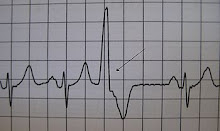
Bi-annual: I've always been confused by this term. Meaning "happening twice every year" or "occurring every other year"? According to ye old internet, both are acceptable definitions. I try to go to my cardiologist every other year. Since my condition is benign, I probably don't have to go at all, but I always love the reassurance. And recently, the palpitations had been getting me down a bit and I've had a couple weird sleep disturbances (adrenaline rushes and breath holding incidences). So it was time to go back to the Doc's for a bi-annual check-up.
I love my cardiologist, do you? It took me many years and many different doctors before someone took the time to listen to me and reassure me with appropriate language. One of my first cardiologist was the type to quickly listen to my symptoms, give me a work-up (EKG, echocardiogram, holter monitor) and then deduce that I just needed to get a grip on my anxiety. "But Doctor," I would cry, "my anxiety is my heart palpitations." The second doctor I saw was a very nice guy. He was a bit of a grandfather figure whereby on the way out the door he would give me a hug and say something like, "I see people with serious heart problems every day. You should count yourself as one of the lucky ones." I know he meant well, but it made me feel small and silly. Finally, I found a wonderful cardiac electrophysiologist. He immediately took my condition serious because of some family history. At every visit, he will listen to my concerns, give me an EKG, look at my QT interval, discuss natural and medicinal approaches, and encourage me to keep working on not letting them get me down. He has great bedside manner--speaking with confidence and compassion. For example, I told him that I recently have had this morbid fear that I'm going to die in my sleep. We went over a previous sleep study I had done over 10 years a go, and then reassured me that he is absolutely certain that whatever is going on with me during my sleep is not a cardiac event. He said, "I can promise you that you are NOT going to die in your sleep." And then we laughed that well maybe it was something might happen when I'm in my 80s or 90s but not right now. And then of course, at that age, isn't that how everybody wants to go out?
Since that visit a week a go today, no more morbid thoughts. I've been sleeping better and feeling much more rested. And if I still continue to be bothered by sleep disturbances, he recommended two wonderful sleep specialists in my town. We'll see how it goes.
Thursday, February 7, 2013
My bi-annual appointment

Friday, January 6, 2012
A Funny Thing Happened on the Way to the Delivery Room
My beautiful and healthy (praise God) daughter was born November 17, 2011. We are all doing extremely well. A bit sleep deprived, but adjusting well to a family of four. My older daughter is in love with her new baby sister and has been a great helper. Labor was a bit more difficult than with my first as I labored a lot longer without an epidural. After experiencing intense contractions 3-5 minutes apart for over 8 hours, it was time the anesthesiologist came in. As he started prepping me, he started asking me the standard questions, such as have I ever had heart disease, etc. Seldom do doctors ask about heart arrhythmia per say so I went ahead and started filling him in. While groaning through contractions, I spoke of PVCs, and of bigeminy, of my cousin and possible Long QT in our family. I mumbled stuff about tachycardia and fibrillation. That's when the anesthesiologist looked up from his paper he was taking notes on and asked "Are you a nurse?" I asked why he thought I was one and he told me that the terms I was throwing out made it seem like I had a medical background. Ha! Nope, I've just experienced these little buggers for so long, and I have wanted to educated myself about my heart. I actually took it as a great compliment. You always hear that you have to be your biggest health advocate and the fact that I was able to convey my medical history (even in great pain) made me proud. The epidural took and less than 2 hours later and a few pushes, my daughter was out. Recovery has been relatively easy, and post partum I haven't experienced too many premature ventricular contractions - medical jargon for "the dance". I bet the anesthesiologist would have even gotten a greater kick out of it if he had known I blog about the subject.
Wednesday, March 16, 2011
My annual appointment
to visit my cardiac electrophysiologist is scheduled for this coming April 1st. Yeah, April Fool's day. Not sure what I was thinking when I scheduled it for that day. Also, I haven't exactly gone in for my annual (making it my triennial?) the past couple years since becoming a mom. I'm hoping all will be well with my EKG. I'm currently trying to come up with a list of questions I'd like to ask my doctor. It's always a good idea to write down your questions that you'd like to discuss with your doctor; otherwise, you're likely to forget, and then you just blew your valuable co-pay. I promise to update after my appointment.
Update: All went well. My EKG looked great and my QT interval looked normal. They're always checking my QT interval due to my cousin's sudden death. I have to say I like my doctor a lot. He listens attentively and without judgment. He takes your concerns serious, but doesn't freak you out. He doesn't rush you out of the office, and he always makes sure I feel confident about everything before I leave. He is always so reassuring, that for weeks after an appointment I hardly give notice to the thumps and skips of my heart.
Tuesday, February 22, 2011
As Seen on The Doctors

I was flipping through the channels this afternoon and (to my delight) caught a short segment about heart palpitations on the television show The Doctors (aka America's Medical Dream Team).
They had a young woman on the show named Sarah who complained of heart palpitations along with feelings of her heart racing, being unable to catch her breath, and feeling faint without actually fainting. The young woman was visibly quite scared.
The Doctors mentioned that the woman had an underlying cause that was most likely attributing to her heart palpitations. Want to take a guess of the cause?
If you guessed Mitral Valve Prolapse, you're right! I've talked a little bit about MVP before on my blog, but here's a crash course if you can't remember. Mitral valve prolapse (MVP) occurs when the valve between your heart's left upper chamber (left atrium) and the left lower chamber (left ventricle) doesn't close properly. When the left ventricle contracts, the valve's flaps bulge (prolapse) upward or back into the atrium. Mitral (MIE-truhl) valve prolapse sometimes leads to blood leaking backward into the left atrium, a condition called mitral valve regurgitation.
Dr. John Kennedy on The Doctors, said that most likely the regurgitation was "tickling" or "irritating" Sarah's heart and thus the heart palpitations.
Sarah wore a 24 hour holter monitor and completed a 30 day event monitor for prognosis. The results were that even when she was palpitating she overall had a normal sinus rhythm. Sarah was going to be okay.
The Doctors urged her to lower her stress levels whether it be "trying a yoga class" or "reading a book."
Disclaimer: When watching The Doctors, if you are a woman, you may want to use caution when looking at Dr. Travis Stork (a former Bachelor on ABC's The Bachelor). He has been known to make a woman's heart start palpitating.
Saturday, October 9, 2010
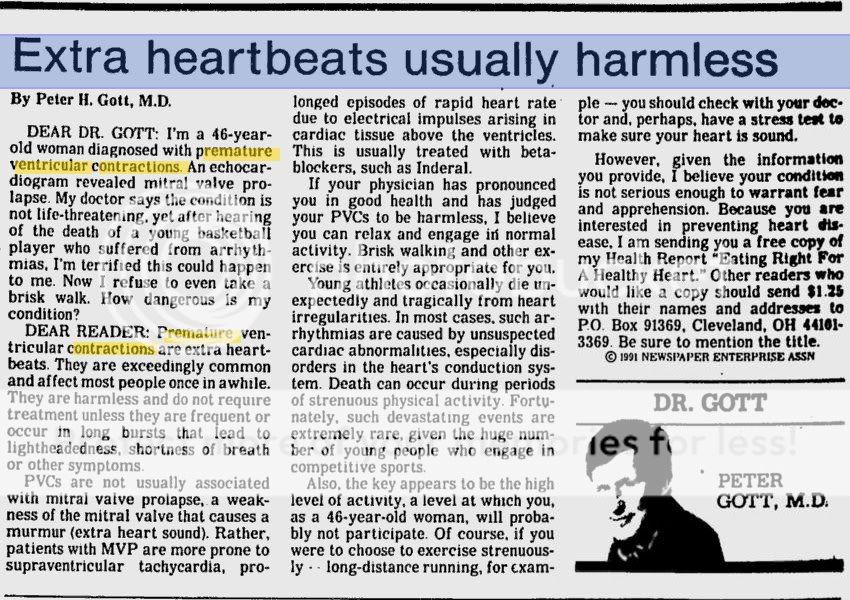
Oldie But Goldie by Dr. Gott
The Nevada Daily (Feb. 18, 1991)
Click on the article to read the full article
'Hungry Heart Syndrome'
Never heard it called this before. But according to a 1974 article appearing in The Ledger, a doctor believed his premature beats (PVCs) were due to his heart being "hungry." Supposedly he noticed his premature heart beats approximately one hour before meals and stopping within 10 to 15 minutes after eating. Thus, he coined the phrase "hungry heart syndrome." Interesting. Never really noticed a strong correlation between PVCs and hunger but I'm sure I've experienced this phenomenon on occasion. I like how he found that eating 6 small meals a day lessened their irregularity (something that is in vogue right now with diets), but that unfortunately he gained 10 pounds. Ha, sort of funny. But good to hear that a doctor actually felt them and didn't say it was all in his head.
Have you ever noticed a correlation between PVCs and hunger?
Hungry Heart Syndrome Article (The Ledger, Feb. 1, 1974)