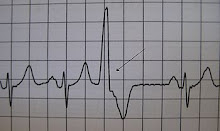
I mentioned in my last post, that I tend to experience more palpitations when I lay on my left side before falling asleep. So, I usually find relief when I flip over and lay on my right side. I've heard conflicting thoughts about whether to lay on your left or right side. I'm of the mind, you do what works best for you.
But since I'm curious, do you find a better side to relieve heart palpitations when you lay down? I'd love to hear from you.
The right side vs. the left side???
Showing posts with label relief. Show all posts
Showing posts with label relief. Show all posts
Wednesday, August 17, 2011
Left or Right Side?

Tuesday, February 22, 2011
Wonders and Worries Poster
So if you know anyone that has a chronic illness or condition and has kids you may want to try this idea that my friend who suffers from epilepsy did. And even if you don't have kids, you may want to try this project to help vent your own frustrations about your chronic condition.
My friend had a really rough end of last year with hospital stays, grand mal seizures, and a new medication that made her drowsy and forgetful. She said she felt like she was in a very deep fog. She had to sleep A LOT more because if she didn't it would bring on more stress and thus more seizures. She came to a Christmas party and told me later she doesn't even remember going to it. Since she had a big seizure in December, the State of Texas requires her to wait at least 6 months before she can drive again.
My friend has a kindergartner.
She said through all of it, she mostly worried about her child and how he felt watching his mother suffer so much from epilepsy last year. She reached out in her community and discovered a local organization called Wonders and Worries. The non-profit, free-of-charge organization counsels children in understanding the situation and handling the potential negative effects of a parent with a chronic or life-threatening illness. She said one of the ideas that the organization told her about was to create a poster that both her and her child could do together. The poster they would create was entitled "Why Epilepsy Sucks". They cut out images from magazines or drew pictures on their poster board that represented the negative effects of her disease. For example, they had a picture of a car (because she could no longer drive), a bed (because she spent so much time in it), a house (because they couldn't go out as much), a dad (because her son had to spend a lot more time with him), a doctor's office and a hospital (because she spent a lot of time there), a sad boy (because he worried about his mother), etc.
My heart arrhythmia condition and panic disorder has definitely caused me to worry about its effects on my child. I've wondered if I'll ever be incapacitated by it, will she inherit it, will I have to miss important events in her life because of it, will she worry about me. The list could go on and on. Right now, I'm a highly functioning person despite it, but I worry that some day I might not be. I've had anxiety episodes where I can't drive, go out, or sleep well at night. I've had arrhythmia episodes where I've had to remove myself from a place or situation to get my heart's rhythm back under control. Or I've had to sleep a lot to reduce stress and induce relaxation. So just knowing that there are places out there and things our family can do if my condition worsens gives me much peace. I will definitely try a "Wonders and Worries Poster" if ever need be with my daughter.
Thursday, December 16, 2010
Crazy Heart
Several months a go, my husband and I sat down to watch "Crazy Heart," the 2009 musical-drama film starring Jeff Bridges (who went on to win the Academy Award that year for Best Actor) who plays a down-and-out country music singer-songwriter named Bad Blake. Blake tries to turn his life around after beginning a relationship with a young journalist portrayed by Maggie Gyllenhaal. I heart the movie but I especially loved the music. The original music was composed by T-Bone Burnett, Stephen Burton, and Ryan Bingham. Bingham and Burnett received the Academy Award for Best Original Song for co-writing "The Weary Kind," which Bingham also performed.
I have since downloaded "The Weary Kind" on my ipod and the soulful and haunting lyrics move me to tears every time. And although I'm sure the lyrics are all about booze, hard living, and lost dreams, something in it resonates with me. The chorus states:
And this ain't no place for the weary kind
this ain't no place to lose your mind
this ain't no place to fall behind
pick up your crazy heart and give it one more try
So although I've had a particularly rough end to the year with lots of heart palpitations, anxiety, fatigue, and stress, my soul tells me to "pick up my crazy heart and give it one more try."
Tuesday, October 5, 2010
My Own Happiness Project
Now that I finished reading The Happiness Project (see my previous blog), I've decided to come up with some resolutions of my own. These are things that either brought or currently bring happiness to my life. And since Rubin worked on one resolution per month, I thought I would come up with at least 12. The list is in no particular order.
1) Blog regularly
2) Jog at least 3 times a week
3) Make time for yoga/meditation
4) Be musical (start playing the piano again and singing in the choir)
5) Dance
6) Laugh more
7) Keep 9 to 10 p.m. for my husband Jake
8) Mission/Volunteer
9) Pray
10) Contemplate the Heavens (remember my loved ones)
11) Read novels written in Italian
12) Renovate my kitchen
Do you have resolutions of your own? I would love to hear what some of you do to make yourselves happy! :)
Sunday, October 3, 2010
Pat the Cat

I've recently been reading The Happiness Project by Gretchen Rubin and although most of the book is pretty general about how to be happy (i.e. get more sleep, exercise, start laughing more, find your interests, etc.), I was struck by the reminder that "regularly having fun is a key factor in having a happy life; people who have fun are twenty times as likely to feel happy." And I wonder when I start experiencing heart palpitations (which are obviously no fun), how much fun had I been having prior to their onset? Most likely, not so much. In fact, if stress is the number one reason for my heart palpitations, how can I de-stress? Be serious about play. As Rubin explored how to have more fun, her friend posed the question to her: "What did you like to do when you were a child? What you enjoyed as a ten-year-old is probably something you'd enjoy now." As I muddled this over in my head, I tried to think of some of the things I liked to do as a ten-year-old. I loved to read books, play with friends, cuddle my cat, dance to music, draw/color, play house, and ride my bike. Some of these things I still do such as reading and obviously "playing" house. But some of these things I haven't done in a long time. When is the last time I put on the Ventures and danced to "Walk, Don't Run"? Last night, I woke up around 1 a.m. I was nervous before I fell asleep because I was afraid I might have another panic attack, and sure enough the anticipatory anxiety woke me up in the middle of the night. As I could feel my anxiety level rise, I thought about what I had enjoyed as a child. I turned myself over in bed so that my head was now at the end of the bed and my feet were on my pillow. My cat Quinn was curled up in a small ball. I started petting him and the sweet sound of his purring soothed my soul. I remembered fondly the days of petting my childhood cat, Midnight. I felt at peace, and it was so wonderful to do something childlike again. Something so simple, but something I had long neglected. I simply got to pet my cat. I fell peacefully asleep to the hum of his tiny motor.
Saturday, July 31, 2010
Me Day
Everybody needs a day to themselves every once in awhile, especially people that suffer from chronic anxiety and stress related palpitations. After another busy week playing host to my dear sweet sister-in-law, I was ready for a break this weekend. My husband took my young daughter and headed out of town to his parent's house today. That meant I got a Me Day. I started my day by going to get a pedicure with a friend. Then, it was off to the grocery store. Now, that might not sound like too much fun to you, but you have to believe me, it is when you are WITHOUT child. I came home and after fixing me a yummy lunch, I fell asleep for a couple hours. I woke up and decided I wanted to go swimming. Again, swimming is a completely different experience when you aren't worrying about swim diapers and flotation devices. I lounged by the pool and read a good book. I then came home and took a shower. I actually had time to put in a hot oil treatment and scrub my face. I even started singing in the shower--since no one was around to hear it. Now, I'm trying to decide what steamy romance to watch tonight. I could feel my stress level drop every hour today. I'm thankful to my husband for giving me such a wonderful treat.
No palpitations for me today. :)
Saturday, July 24, 2010
They're back, and I'm back
My respite from palpitations a couple months a go has given way to a vengeance of them the last couple of weeks. Last Saturday evening, I had the worst case of them I've had in years. I had just laid down to go to sleep when they started to rear their ugly heads. The end of a day seems to be a common trigger for many of my palpitations. I'm not sure if I'm just not feeling them during the day and then when I go lay down, I start to notice them or if they are just they byproduct of a long stressful day. Usually, I believe it's the latter. A couple whumps later, I can tell my anxiety level starts to rise. I start to practice my deep breathing, but then my mind starts to play little tricks on me like "Uh oh, what if they don't stop? What if I start getting more of them? What if I have to go the hospital?" And as soon as that negative anticipatory anxiety starts, I get more and more of them. Pretty soon, I was in bigeminy or trigeminy where I started getting them every other or every third beat. I would exacerbate the condition when I started putting pressure on myself to "beat these pvcs" after all I'm an expert on them now, right??? I continued to deep breathe and then decided I would try talking to my husband for distraction. I started telling him all the things I had on my plate right now and all the stresses and worries I'm dealing with. That helped a lot and before I knew it, a gentle peace enveloped me and I fell asleep. I remember waking up around 3 a.m. in the morning excited that I had gotten some sleep and that the pvc's were no longer bothering me. Every time I'm successful at accepting and dealing with them, I'm encouraged that I do have the power to make them stop. I don't need a magic pill or a doctor to help me through them. I have me. My mind and attitude is my greatest ally.
But even after that successful night of stopping them, palpitations continued to bother me off and on throughout the week. It was the week before my period was to begin, and I firmly believe (although some male doctors won't admit it) that the fluctuating hormones played a role in the abundance of pvc's that I experienced this week. I also went out of town for a week and although vacation can be relaxing, just the change of routine, most likely contributed to them. I got back late yesterday and instead of relaxing and taking it easy I went over to a friend's party. As I was sitting outside in the hot and humid late afternoon sun she handed me a Mexican martini. I knew I was dehydrated and should have been drinking water, but I started to sip on the alcohol anyway. A couple minutes later, whump...whump...whump. My heart was skipping in a dance. We excused ourselves early. I went home and took a shower. They were still bothering me but when I sat up in a meditative pose and started to breathe in and out fully to counts of 3, 4, 5 and they started to diminish. My husband came in and gave me a back massage and once again, I started talking through all my worries. And guess what? The palpitations disappeared after an hour or so. I was able to go to sleep without any trouble and woke up late the next morning feeling refreshed and energized.
Tuesday, June 15, 2010
Remission
Many people that have chronically suffered with heart palpitations know that for whatever reason sometimes we get a break and don't suffer from them as much. Some people say they had them for several years straight after a stressful event in their lives. Then they go away, only to return many years later. I've never been fortunate not to have been bothered by them for years at a time, but I definitely have weeks and months where I won't have any sensation of them. Right now I'm in my brief remission. It could be because I'm currently taking pretty good care of myself with exercise and healthy eating. Or I could attribute it to finding my groove with motherhood and still finding time to do things I enjoy. Whatever it is, I'm reveling it. I'm accepting this time of remission with joy but not expecting it to continue indefinitely. One day (hopefully not too soon), life is going to throw me a curve ball. And most likely my body will respond with palpitations. But "the dance in my heart" is always a good indicator that I need to slow down and relax. And the cycles of arrhythmia and remission will repeat itself. I have learned to take solace in the knowledge that whatever discomfort I may be feeling, one day soon the palpitations will pass.
Wednesday, June 2, 2010
Signore Antonio Maria Valsalva

I love that I have the emotional and fiery temperament of an Italian. Of course, my husband loves to point out that I'm really only one quarter Italian, but in my eyes, I'm 100%. Perhaps my personality makes it so I have more run ins with palpitations than the chillaxed kind of person.
But Dr. Gary Francis, director of the coronary intensive care unit at the Cleveland Clinic Foundation, thinks that the solution to relieving palpitations may be in doing a maneuver that was developed by none other than an Italian.
Forcible exhalation against a closed airway was originally described as a method for inflating the Eustachian tube, and its diagnostic use has been attributed to Antonio Maria Valsalva (b. 1666- d.1723). Francis says that a similar move may help in derailing palpitations. Dr. Francis says that the next time you start experiencing heart palpitations you may want to try the Valsalva's maneuver. Pinch your nose and close your mouth. Then blow out while keeping your nose and mouth shut. The built-up pressure in your nose and mouth can force your heart back into its normal rhythm.
Hey, it's worth a try. Grazie Antonio!
[Precautions: The Valsalva maneuver should not be performed by patients who have severe coronary artery disease , have experienced recent heart attack, or have a moderate to severe reduction in blood volume.]
Tuesday, June 1, 2010
Cough It Up
If your drum isn't giving you a steady beat, start coughing. Cough during your next heart palpitation episode. The force of the cough will sometimes get a heart back on its regular track, says Robert March, M.D., associate professor of cardiovascular surgery at St. Luke's Medical Center in Chicago. A good cough can break the pattern of the palpitation.
[I know that I instinctively start to cough when I start to experience them. My husband always knows when I'm getting them because I'll start coughing abruptly. And forget about having time to cover my mouth with my sleeve. Ha!]
Please don't confuse this with "cough CPR" or the attempt of a conscious person to forcefully start coughing to maintain blood flow to the brain during a heart attack. Coughing to alleviate heart palpitations is only recommended during brief arrhythmia.
From the American Heart Association website (http://www.americanheart.org/presenter.jhtml?identifier=4535):
The American Heart Association does not endorse "cough CPR," a coughing procedure widely publicized on the Internet. As noted in the 2005 American Heart Association Guidelines for Cardiopulmonary Resuscitation and Emergency Cardiovascular Care, the American Heart Association DOES NOT TEACH THIS AS PART OF THE CORE CURRICULUM IN ANY COURSE.
During a sudden arrhythmia (abnormal heart rhythm), it may be possible for a conscious, responsive person to cough forcefully and maintain enough blood flow to the brain to remain conscious for a few seconds until the arrhythmia disappears or is treated. Blood flow is maintained by increased pressure in the chest that occurs during forceful coughs. This has been mislabeled "cough CPR," although it's not a form of traditional resuscitation.
Why isn't "cough CPR" appropriate in CPR training courses?
"Cough CPR" should not be routinely taught in lay-rescuer CPR courses, because it would complicate teaching traditional CPR. It would add information that's not generally useful in the prehospital setting. In virtually all lay-rescuer CPR courses, the finding that signals an emergency is the victim's unresponsiveness. This signals the rescuer to begin the "A, B, C's" of CPR. Unresponsive victims will not be able to perform "cough CPR."
Are there situations when "cough CPR" is appropriate?
This coughing technique to maintain blood flow during brief arrhythmias has been useful in the hospital, particularly during cardiac catheterization. In such cases the patient's ECG is monitored continuously, and a physician is present.
During cardiac catheterization, patients may develop sudden arrhythmias. If a life-threatening arrhythmia is detected within the first 10 to 15 seconds and before the patient loses consciousness, a physician or nurse may tell the patient to cough. Repeated, forceful coughing can help the person stay conscious until the arrhythmia disappears or is treated.
Therefore, the usefulness of "cough CPR" is generally limited to monitored patients with a witnessed arrest in the hospital setting.
AHA Recommendation
The best strategy is to be aware of the early warning signs for heart attack and cardiac arrest and respond to them by calling 9-1-1. If you're driving alone and you start having severe chest pain or discomfort that starts to spread into your arm and up into your jaw (the scenario presented in the Internet article), pull over and flag down another motorist for help or phone 9-1-1 on a cellular telephone.
Drinking for Life

One of the first things you'll hear when your doctor diagnoses you with heart palpitations is to cut out all caffeine. Some people even claim once they cut out coffee, they never had any heart problems again. I had never been a huge coffee or Coke drinker so I knew I couldn't blame caffeine on all my heart palpitations, but I knew it contributed to some. I remember when I was in college, I loved getting a cafe au lait from a local coffee shop. Well, it took one night of experiencing the dance in my heart and I swore I would never drink coffee again. And I haven't. I also try to stay away from soft drinks but I do sip an occasional one for special occasions. But my rules are never drink a Coke when I'm experiencing high levels of stress or late at night. We were in the midst of packing up our apartment and moving into our first home and we knew it was going to be a long night before we had everything ready for the movers. I remember it was a little after midnight, I was worn out from teaching that day, and I thought it would be a good idea to get a little energy boost by drinking a Coke. I guzzled it down and no sooner had I just put the empty can down when my heart paused and let out a hard THUMP. I was tired, I was stressed, and I had just consumed caffeine. Not a good combination.
Another thing that is usually recommended is to eliminate alcohol. I try to limit my alcohol consumption to a small glass of red wine (since it's suppose to be good for your heart) once a week or so. I also like to reward myself for working out and staying healthy with an occasional mixed drink. But that's all. Of course, if you notice heart palpitations after drinking alcohol, put the drinks away.
Previously I mentioned that one of the things I do when I start getting palpitations is to immediately drink a glass of water. A lot of times we are dehydrated and don't even know it. And you've heard it time after time, but I'll repeat it. Make sure you are getting the recommended amounts of water every day, especially in the summer. "Eight 8-ounce glasses of water a day" is a good rule of thumb.
Alternatives to water? While sugar IS something you want to minimize, I would choose small amounts of natural sugar any day, over foods sweetened with high fructose corny syrup or artificial sweeteners like aspartame, saccharin and sucralose (Equal, Nutrasweet, Sweetn'Low, Splenda, etc). The following are some healthy alternatives to water. If you have other suggestions, let me know, as I love trying new healthy drinks.
-Water with lime or lemon or cucumber.
-Decaffeinated hot or iced tea with honey, agave nectar, or lemon
-Green teas (even if you choose decaf you'll still experience some of the healthy antioxidant benefits)
-Smoothies: My favorite recipe is very simple. 1/4 cup apple juice, 1/4 cup water, 1/4 cup blueberries (or other favorite fruit), 1 scoop (10 mg) whey protein powder (vanilla flavored). Blend together and enjoy. This is a perfect snack because it contains 1 block of protein and 1 block of carbohydrates.
-Vegetable juices (Hey Mom, my taste buds are finally tolerating these!)
-Fruit juices (but I always dilute them with at least 50% water)
-Fizzy water (or in Italy it's known as "con fizz") such as Pellegrino
Wednesday, May 26, 2010
When you are experiencing heart palpitations

In a previous post, I discussed all the things I do to be healthy and prevent heart palpitations. But sometimes no matter how well I try to take care of myself, I'll still get those pesky misbeats. This has been an important realization as I used to get very depressed when I thought I was doing everything right and still got them. Now I just know that no matter how well I think I'm doing taking care of myself, life will inevitably get in the way and shake things up. Unexpected events, changes, chasing a toddler, fluctuating hormones, getting cut off on the road, etc. These are things that we have no control over and normal if we are to live full lives. Some stress is good. If we didn't have any, we'd be dead. But what do you do when you are stressed out and feeling the effects of heart palpitations? Here's what has worked for me:
--a glass of water
--splashing my face with cool water
--getting on the floor on my yoga mat and doing some gentle stretches (cat stretch, sun salutation, rock the baby pose)
--deep breathing (you can add meditative music, but sometimes I find it distracting)
--reaching deep inside myself and trusting my heart/body/soul
--reciting the mantra "This too shall pass."
But sometimes just trying to calm down, actually makes me panic more. Sometimes if the above doesn't work, the alternative is to get up and move. Go on a walk. Even if you're experiencing heart palpitations at 2 a.m., get up and start walking circles around your dining room table. Keep breathing slowly. In through your nose, out through your mouth. Or change up the scenery and go outside. You can enlist the help of a friend or spouse, but I've noticed that I really am the only person to help me through a bad episode. And when you have a history of being the one helping you through your panic, you don't have to rely on anyone else in the future.
[Disclaimer: If you have never experienced heart palpitations or have an underlying heart condition, please inform your doctor if you start experiencing them. I've had mine diagnosed as benign PVCs via EKG; thus there is no need for me to go to the hospital when they start bothering me. Of course, if my symptoms ever change or I start to feel lightheaded, I would immediately consult my cardiologist. But I've done the hospital thing in the middle of the night, and all they've ever done is hook me up, say yep you're experiencing palpitations, and send me on my way with a prescription for beta blockers (which I have never filled but that's another topic). So now I know when I start feeling them again, that it's best for me to stay home and work through them on my own.]
Friday, March 19, 2010
Heart Healthy

What do I do to prevent PVCs?
This is my current preventative regime. But basically it's striving for a healthy lifestyle.
Walking/Jogging (30 min.) at least 3 times a week
Eliminate all caffeine (no cokes, no coffee)
Yoga
Deep breathing
Reduce white sugars and carbs
Progressive muscle relaxation
Paraliminals: Self-Improvement Audio programs
P90X: a fitness regime consisting of weights, lunges, core work
6 small meals a day and always pairing a carb with a protein unit
Plenty of water
8-10 hours of sleep
Naps
Down time
Play time
Neck adjustments/massage by a chiropractor
Plenty of fruit and vegetables
Occasional mental health therapy sessions
Limit alcohol consumption (but occasional Mexican martini)
Medication: 15mg. of Lexapro
Subscribe to:
Comments (Atom)